
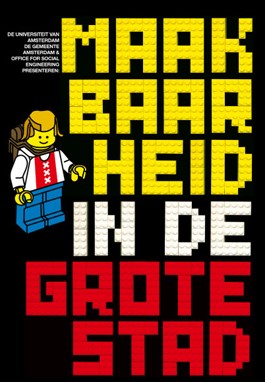
The very best programme that I could witness during more than 30 years at the University of Amsterdam was called “The Makeable City”, designed and supervised by Martijn van Tol, now a Multimedia Journalist and Podcast Producer at DeStudio. Participants got a common office in one of the city’s boroughs (for example in a former snack factory). Their task was to identify the borough’s problems – and then try to solve these problems that they had come across. Examples were the potential conflict between the inhabitants of a new posh quarter and those of the neighbouring area, where mostly migrants live; conflicts around the opening of an asylum centre, and school dropout among girls with a migration background.
This programme had a number of features that could be key to lifelong learning.
- The programme brought thinking and doing together. Participants did not only have to observe and to analyse, they also had to strategize and to try to change the situation for the better. That led to a much deeper insight than would have been possible by lectures and reading alone, because only if you try to change a situation, you encounter the forces that have caused it and tend to perpetuate it. Participants could immediately see the reasons to study, and who would benefit from it.
- They left college halls and worked in an environment that was directly related to the topic of their study. It stimulated their curiosity, and it provided opportunities for immediate feedback on their plans. The subject of study became much more concrete and tangible.
- Participants formed an interdisciplinary team, which was rather free in organizing its own work, to choose the topics they wanted to address, and to invite experts of all sorts. Teachers did give advice, suggested relevant literature and helped to establish contact to different stakeholders, but it was the team itself that could decide how to proceed. Team member did not only gain more knowledge, but also acquired relevant social skills.
This was an excellent example of problem oriented studies, which was highly motivating and provided lasting memories. It bridged the usual gap between theory and praxis, provided ‘hard’ and ‘soft’ skills, and contributed directly to societal change. It brought together many aspects of successful lifelong learning: it stimulated curiosity, got students out of their normal routine, and was immediately relevant for improving living conditions in a specific locality.
 triplelll.nl