
https://www.efma.com/article/detail/30475
The family of Hans Rosling provides a typical 20th century example of upward social mobility. While his grandparents were unskilled labourers in Sweden, he became a medical doctor, a university professor and a worldwide acknowledged statistician (see the three previous blogs).
Past industrial revolutions have lead to more equal opportunities. The typical American dream of starting as a dishwasher and becoming a millionaire mirrors this experience.
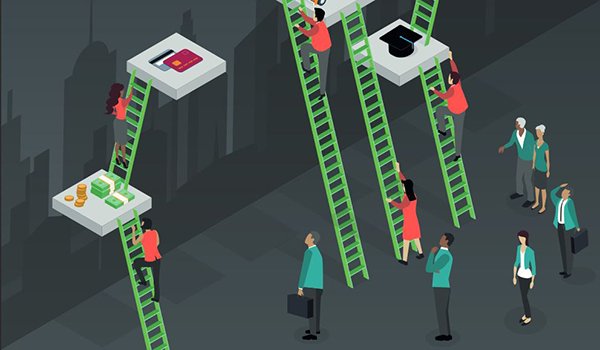
However, as the Global Social Mobility Report 2020 points out, this will probably not hold true for the present industrial revolution which will lead to large scale automation of production and services as a result of global competition, the application of artificial intelligence, and policy choices. We see already now that individual educational attainment tends to be largely determined by that of the parents, and that children no longer fare better than the generation before.
This situation differs from country to country, as shown in the Global Social Mobility Index. The first five ranks with the highest social mobility scores are occupied by the five Scandinavian countries. The first non-Scandinavian country is The Netherlands. Most African countries are at the very bottom of the list.
I ask myself what the consequences will be for lifelong learning. If chances in life are increasingly determined by your starting position, the incentive to invest in lifelong learning might be low, because chances of success are low. There will simply not be enough higher positions to be filled, and chances to climb up are dim, if your parents are not yet part of the higher ranks in society.
 triplelll.nl